Is a Space Maintainer Worth the Cost for My Child?

A Small Gap With Big Consequences
When a baby tooth is lost earlier than expected due to decay, injury, or extraction, the gap it leaves behind does more than affect your child's smile. That empty space is a structural placeholder in the developing jaw. Without something holding it open, neighboring teeth begin to drift toward the opening, often within weeks. What follows can be years of orthodontic correction that a simple appliance placed early could have prevented.
Parents frequently wonder whether the cost of a space maintainer is worth it given that the tooth was temporary anyway. This guide breaks down how these appliances work, what they cost, and what tends to happen when families skip them.
What a Space Maintainer Actually Does
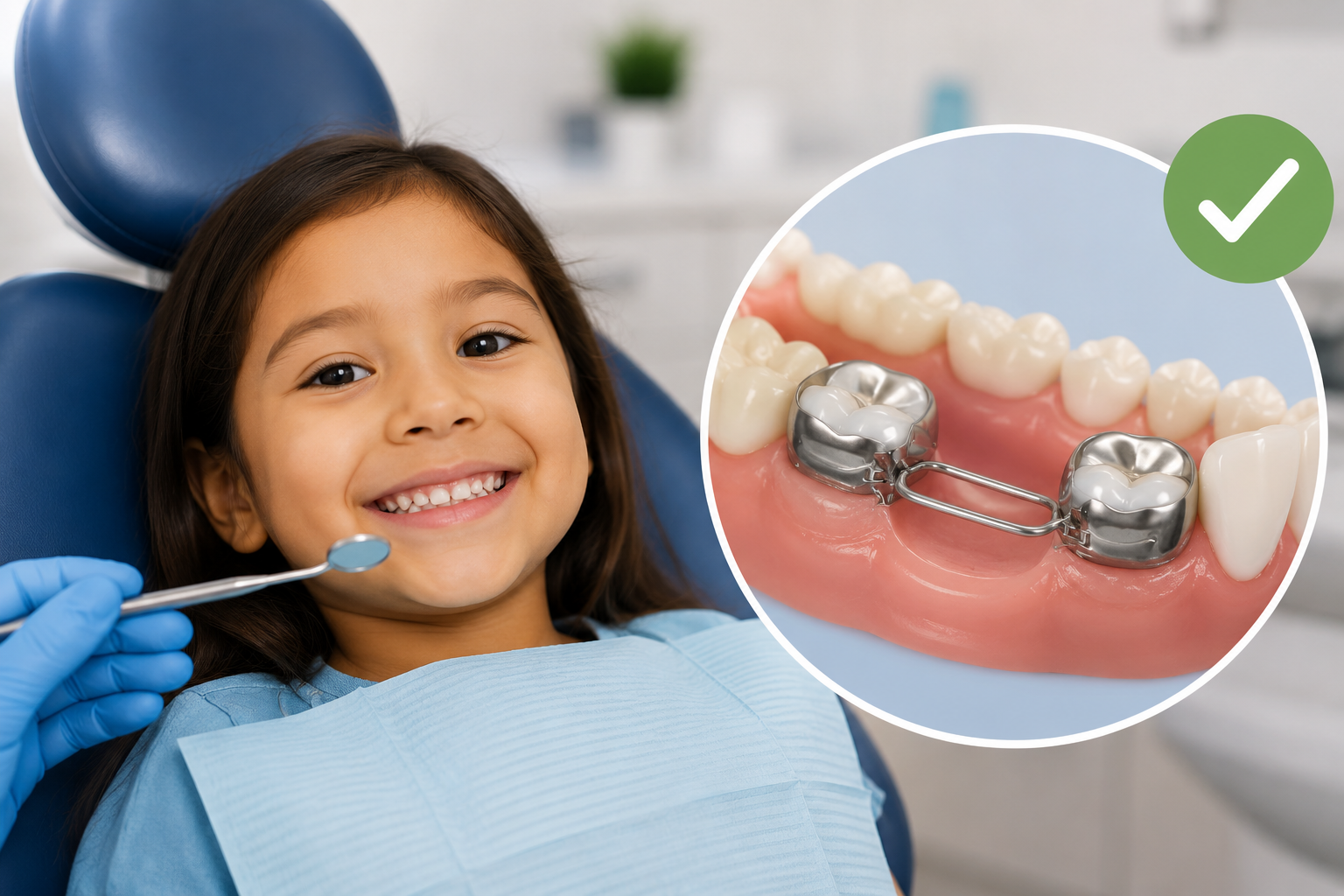
A space maintainer is a small dental appliance made of metal or acrylic that sits in the gap left by an extracted or lost baby tooth. Its purpose is to hold open the space so the permanent tooth developing underneath has room to erupt into the correct position.
In Lehi, Utah, pediatric dentists typically recommend space maintainers when a baby molar is lost before the permanent tooth is ready to emerge. The duration the maintainer needs to remain in place is determined by X-rays that show how far along the permanent tooth is in its development.
Types of Space Maintainers
Space maintainers come in fixed and removable designs, with fixed options being the most commonly recommended for young children who cannot reliably manage a removable appliance.
Band and Loop
The most frequently used design for a single missing tooth. A metal band is cemented to an adjacent tooth and a wire loop extends across the gap to keep it open. It requires no effort from the child to maintain its position.
Distal Shoe
Used when the first permanent molar has not yet erupted. The appliance extends slightly into the gum tissue to guide the incoming molar into the correct path. It is more specialized and used in fewer cases.
Lingual Arch
A fixed appliance for the lower jaw when multiple teeth are missing on both sides. It connects molars on either side of the arch with a wire that runs along the inside of the teeth, maintaining spacing across a wider area.
Removable Maintainers
Similar in concept to a retainer. These can work well for older, responsible children who can wear and care for the appliance consistently. They are rarely recommended for younger children who may lose or forget them.
Space Maintainer Costs and Insurance in Lehi, Utah
The cost of a space maintainer in Lehi, Utah depends on the type of appliance and how many spaces need to be managed. The following table provides a general cost overview.

| Appliance Type | Typical Cost Range | Insurance Coverage |
|---|---|---|
| Band and Loop | $150 – $300 | Often partially covered as medically necessary |
| Lingual Arch | $300 – $500 | Often partially covered as medically necessary |
| Distal Shoe | $250 – $400 | Coverage varies by plan |
| Removable Maintainer | $150 – $300 | Coverage varies by plan |
It is worth calling your insurance provider before the appointment to ask whether the appliance is covered as a preventive or orthodontic benefit. Many plans do cover space maintainers when premature tooth loss is documented.
What Skipping a Space Maintainer Typically Costs
Parents who pass on a space maintainer to avoid the upfront cost often face significantly larger expenses later. When teeth shift into an empty gap, the incoming permanent tooth has nowhere to go. It may erupt crooked, become impacted, or require orthodontic or surgical intervention to correct.
Orthodontic treatment in the United States typically starts at $3,000 and can exceed $7,000 depending on complexity and duration. A space maintainer costing $200 to $400 that prevents even a partial course of braces more than pays for itself. Families in Lehi, Utah who address the issue early consistently face simpler, less expensive outcomes than those who wait.
How the Process Works in Lehi, Utah
Having a space maintainer placed is a straightforward process that most children tolerate easily. Here is what families in Lehi, Utah can expect from start to finish.
- X-rays are taken to evaluate the position of the permanent tooth and confirm that a maintainer is the right intervention.
- The appropriate appliance type is selected based on which tooth was lost and the child's age and cooperation level.
- The maintainer is fitted and cemented in a single appointment, typically taking 30 to 45 minutes.
- The dental team reviews home care instructions, including which foods to avoid.
- Follow-up visits monitor the permanent tooth's progress and confirm the appliance remains properly positioned.
- When the permanent tooth is close enough to erupt on its own, the maintainer is removed — another quick appointment.
Frequently Asked Questions
Does placing a space maintainer hurt?
The process is generally painless. Local anesthetic may be used if any tooth preparation is needed, but fitting and cementing the appliance is well tolerated by most children.
How does my child care for a fixed space maintainer?
Children with fixed maintainers should avoid sticky and chewy foods that could dislodge the appliance. Regular brushing and flossing around the appliance are important, and the dental team will demonstrate technique at the placement appointment.
What if the maintainer falls out?
Contact the dental office promptly. Teeth can begin shifting within days of a maintainer becoming dislodged, so timely recementation is important.
At what age do children most often need space maintainers?
Space maintainers are most common for children between ages 3 and 12, depending on which tooth was lost and when its permanent replacement is expected. The dentist determines timing based on X-rays and development stage.
Can a space maintainer affect my child's speech?
Some children notice a brief adjustment period in speech, especially with lingual arches. This is temporary and resolves as the child gets used to the appliance, usually within a week or two.
Conclusion
A space maintainer is one of the most cost-effective preventive investments in pediatric dentistry. The upfront cost is modest; the alternative often is not.
Lehi Pediatric Dentistry in Lehi, Utah helps families understand when a maintainer is the right step and guides them through the process from evaluation to removal. If your child has lost a baby tooth earlier than expected,
call the office to schedule an evaluation.