Does My Child Really Need a Baby Tooth Crown?

The Question Every Parent Asks
If your child's dentist has recommended a crown on a baby tooth, your first instinct might be to push back. The tooth is going to fall out anyway, so why spend the money or put your child through the procedure? It is a fair question, and the answer reveals something most parents do not realize: baby teeth do far more structural work than they appear to, and the consequences of leaving a damaged one untreated are almost always worse than treating it.
This guide explains why pediatric crowns are recommended, what conditions call for them, and what happens when a family chooses to wait.
Why Baby Teeth Matter More Than Most Parents Realize
Baby teeth, or primary teeth, are not placeholders. They hold space in the jaw for permanent teeth still developing underneath the gumline, support proper speech development, and guide jaw growth and facial structure. Losing one too early, or leaving one severely damaged, disrupts that entire process in ways that can be costly and difficult to correct.
Parents in Lehi, Utah often ask whether aggressively treating a baby tooth makes sense when it will eventually fall out. From a pediatric dental standpoint, the answer is almost always yes. The consequences of doing nothing are frequently more extensive than the treatment itself.
Conditions That Typically Require a Pediatric Crown
Not every cavity leads to a crown recommendation. Dentists weigh several factors before suggesting this level of restoration. The following conditions commonly require a crown rather than a standard filling.
Extensive Decay
When a cavity has destroyed too much tooth structure, there is not enough healthy material left for a filling to bond to reliably. A crown restores full coverage and strength.
Post-Pulpotomy Teeth
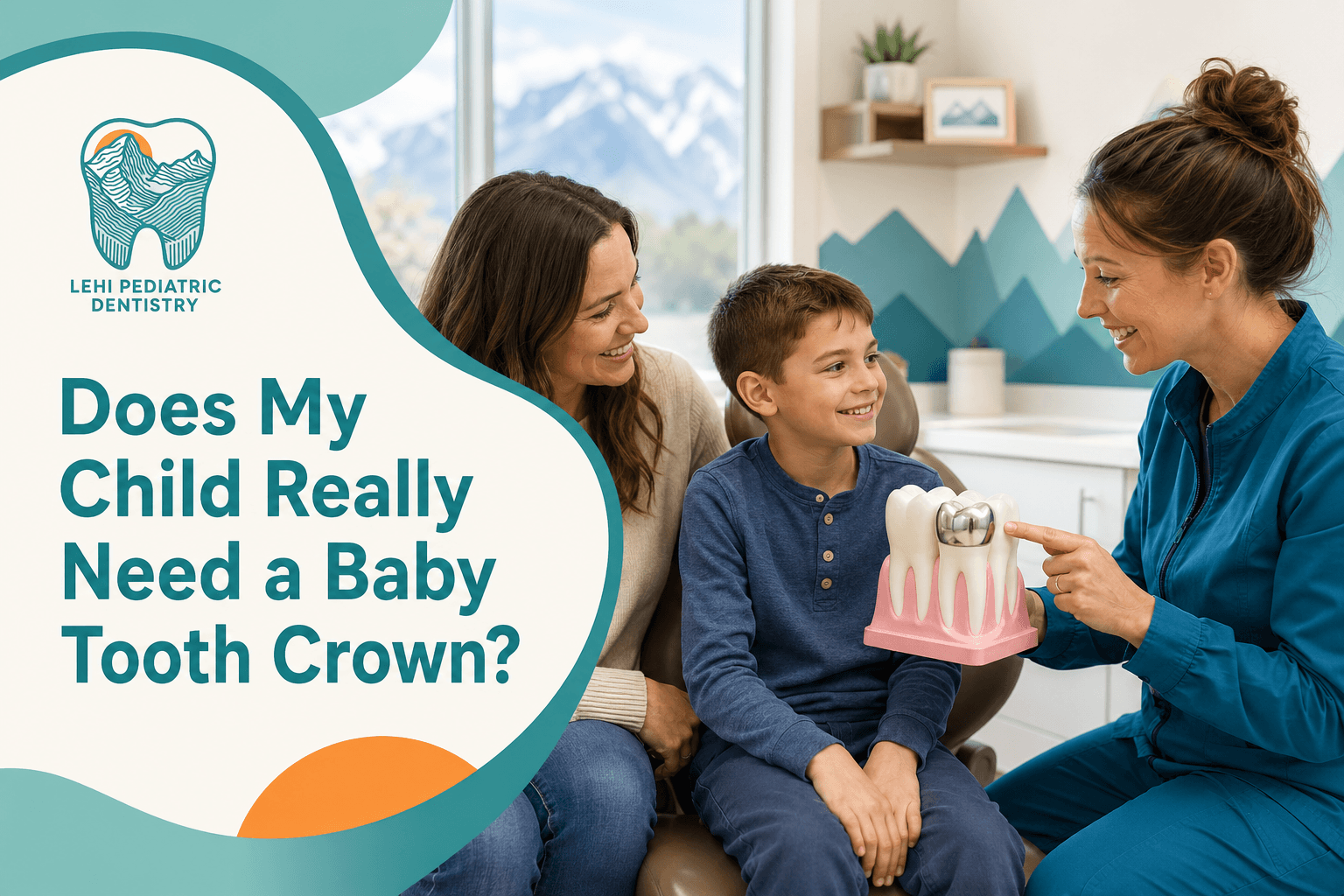
A tooth that has undergone a pulpotomy, commonly called a baby root canal, becomes significantly weaker afterward. A crown protects what remains and keeps the tooth functional until it falls out naturally.
Fractured or Broken Teeth
Trauma, a fall, or biting something hard can crack or break a tooth in ways that cannot be repaired with bonding or a filling alone. A crown restores the tooth's shape and prevents further fracturing.
Developmental Enamel Defects
Some children are born with weaker enamel due to conditions like hypoplasia. These teeth are more vulnerable to decay and often need full coverage earlier than healthy teeth would.
Young Children Who Cannot Tolerate Multiple Visits
For a toddler who cannot cooperate through several lengthy appointments, completing the restoration in a single crown placement is often the more humane and practical approach.
Types of Crowns Used in Pediatric Dentistry
Three main crown materials are used in pediatric dentistry, each suited to different situations. The right choice depends on which tooth is being treated, how visible it is, and the family's preferences.
| Crown Type | Best Used For | Key Benefit |
|---|---|---|
| Stainless Steel | Back molars | Extremely durable, single appointment, cost-effective |
| Zirconia (Tooth-Colored) | Any tooth where appearance matters | Matches natural teeth, mercury-free |
| Composite Strip Crown | Front teeth | Natural look, conservative fit |
What Crown Placement Looks Like in Lehi, Utah
Many parents in Lehi, Utah feel less anxious once they understand exactly what the appointment involves. Crown placement is completed in a single visit and follows a consistent sequence of steps.
- The tooth and surrounding area are numbed with local anesthetic so the child remains comfortable throughout.
- The dentist removes all decayed or damaged tooth structure, leaving a clean foundation.
- The crown is sized and fitted to match the spacing and bite of the surrounding teeth.
- The crown is cemented securely into place and the bite is checked for proper alignment.
- The child is given home care instructions before leaving the appointment.
The entire process takes less than an hour. Pediatric dental teams in Lehi, Utah use child-friendly language and a step-by-step approach to explain what is happening before it occurs, which significantly reduces anxiety for children and parents alike.
What Happens If You Skip the Crown
Choosing to wait or avoid treatment almost always leads to a more complicated situation. A badly damaged baby tooth can develop an abscess, which is a painful infection capable of spreading to surrounding teeth and even the developing permanent tooth directly below it.
Early tooth loss from untreated decay causes neighboring teeth to drift into the gap, closing off the space the permanent tooth needs to erupt into. This leads to crowding, bite misalignment, and often the need for orthodontic treatment. For families in Lehi, Utah, the short-term savings of skipping a crown rarely outweigh the long-term costs that follow.
Frequently Asked Questions
Will my child feel pain during the crown procedure?
Local anesthetic is used before any work begins. Most children feel little to no discomfort during the procedure. Some mild soreness after the anesthetic wears off is normal and manageable with children's pain reliever.
How long does a baby tooth crown last?
Pediatric crowns are designed to last until the tooth falls out naturally. Stainless steel crowns in particular are very durable and rarely need replacement during the life of the primary tooth.
Will the crown affect my child's speech or chewing?
No. The crown is sized and shaped to match the original tooth as closely as possible. It should not interfere with speech, chewing, or the alignment of surrounding teeth.
Can my child eat normally after getting a crown?
Yes. It is generally recommended to avoid very sticky or hard foods for the first day or two. After that, normal eating can resume without restriction.
Does a crown on a baby tooth need to be removed when the tooth falls out?
No. The crown comes out naturally along with the tooth root when the baby tooth exfoliates. No separate removal procedure is needed.
Conclusion
A crown recommendation on a baby tooth is not an overreaction. It is a carefully considered decision rooted in protecting your child's comfort, jaw development, and future dental health.
Lehi Pediatric Dentistry in Lehi, Utah takes the time to explain every recommendation, answer parent questions thoroughly, and create an experience that works for the child. If you have concerns about a crown recommendation,
call the office to schedule a consultation.